Insurance Restoration
Insurance Restoration: Storm & Water Damage Repair
Professional storm damage, water damage, and insurance claim restoration in Upstate SC — from a free consultation to full quality repairs. Scott Burch personally oversees every project.
Cost Range
Custom Quote
Timeline
Varies by Scope
Experience
Since 1995
Rating
BBB A+ Rated
Insurance Restoration & Repair Services at a Glance
Burch Contracting repairs storm, wind, hail, fallen-tree and water damage to homes in Simpsonville, Greenville, Fountain Inn, Mauldin and Laurens County, working alongside the homeowner's insurance claim. As a licensed general contractor (SC #CLG118679) we assess the damage, document it, write the repair scope and rebuild: roofing, framing, drywall, flooring and finishes under one contract. The consultation is free and every job is quoted to its own damage.
- Typical cost
- Custom Quote
- Typical timeline
- Varies by Scope
- Damage we repair
- Wind and hail, fallen trees, roof leaks, plumbing and appliance water damage, and the interior damage that follows
- Our role
- Repair contractor: we document the damage and do the work; your insurer's adjuster settles the claim
- Permit
- Structural, roofing, electrical and plumbing repairs are permitted like any other construction; we pull them
- Who does it
- C. Scott Burch, SC Licensed General Contractor #CLG118679, repairing Upstate homes since 1995
Do you work with insurance companies on storm and water damage claims?
Yes. We communicate clearly with your insurance company throughout the claim, and a detailed written estimate with full documentation is available for a fee, credited back if you hire us. Scott Burch personally oversees each restoration project so the repairs are handled correctly and to standard.
What types of damage do you restore?
We handle storm damage, water damage, wind and hail damage, and general insurance-claim repairs across Upstate SC, from a free consultation through full-quality repairs.
How does the insurance restoration process work?
It runs in three steps: a free consultation to discuss the damage and get a ballpark range, a detailed on-site assessment with professional documentation and a written estimate (available for a fee, credited back if you hire us), and then quality repairs completed once the work is approved.
Will you provide documentation for my insurance claim?
Yes. A detailed written estimate with full documentation to support your insurance claim is available for a fee, which is fully credited toward your project if you hire us.
Insurance Restoration & Repair Services Process at a Glance
| Step | Stage | What Happens |
|---|---|---|
| 1 | Free Consultation | Discuss the damage and situation. Get a ballpark range. |
| 2 | On-Site Assessment | On-site inspection and a free ballpark range. A detailed written estimate with full documentation is available for a fee, credited back if you hire us. |
| 3 | Quality Repairs | We complete the approved work with full attention to detail. |
What to Do in the First Days After Storm or Water Damage
Most homeowner policies expect you to protect the house from further damage once it is safe to do so, and they generally cover reasonable temporary repairs. The order below keeps you safe, protects the claim and gets the repair started.
- Safety first. Stay clear of downed lines and trees on the roof; shut off water or power to affected areas if you can do it safely.
- Photograph everything before anything is moved or cleaned up: the outside, every damaged room, and close-ups of the damage.
- Stop further damage. Tarp an open roof, board a broken window, stop a leak. Keep receipts for anything you buy or pay for.
- Start drying right away. The EPA advises drying water-damaged materials within 24 to 48 hours to prevent mold. A large water loss usually starts with a water-mitigation company; the rebuild comes once the structure is dry.
- Report the claim to your insurance company and note the claim number and adjuster's name.
- Get a contractor's assessment so the repair scope is written by someone who will actually build it.
Types of Damage and What the Repair Involves
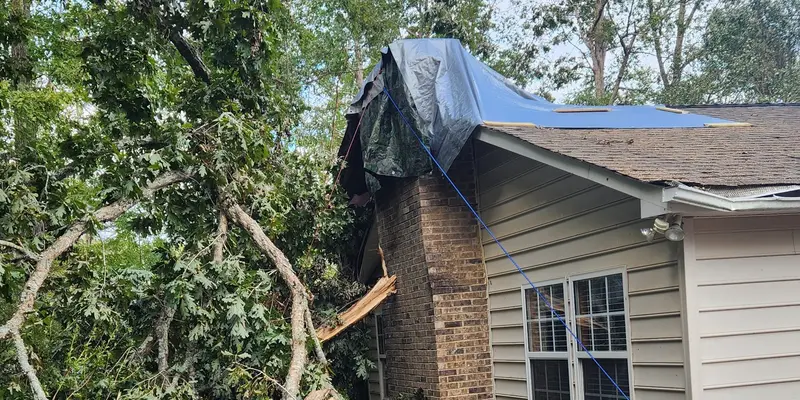
Severe thunderstorms, hail and the remnants of tropical systems all reach the Upstate; the remnants of Hurricane Helene in September 2024 brought down trees across the region. Tree damage is often worse than it looks from the yard, because a trunk that cracks a rafter can also load the walls and ceiling beneath it. We look at the framing, not just the shingles.
| Damage | Typical first step | What the repair usually involves |
|---|---|---|
| Fallen tree | Tree removal by a tree service; roof tarped | Rafters or trusses, roof sheathing and shingles, ceilings, insulation and interior finishes under the impact point |
| Wind | Tarp missing shingles or siding | Roofing and siding replacement, flashing, gutters, sometimes fascia and soffit |
| Hail | Inspection of roof, gutters, siding and window screens | Roof replacement where the shingles are damaged, siding and gutter repair |
| Roof leak | Stop the leak; dry the attic and ceiling | Roof repair, then drywall, insulation and paint inside |
| Plumbing or appliance leak | Shut off water; dry the structure | Subfloor and flooring, cabinets, drywall, baseboards — often in a kitchen, bath or laundry |
Who Does What in an Insurance Claim
Three different people can be involved in a property claim, and it helps to know which is which. In South Carolina, insurance adjusters and public adjusters are licensed through the SC Department of Insurance. A contractor is not an adjuster and should not act as one.
| Who | Works for | What they do |
|---|---|---|
| Insurance company adjuster | Your insurer | Inspects the damage, applies your policy and sets the claim amount |
| Public adjuster | You (licensed by the SC Department of Insurance) | Represents you in presenting and negotiating the claim, for a fee |
| Contractor (us) | You | Assesses and documents the damage, writes the repair scope and does the repairs |
Our Simple Process
-
1
Free Consultation
Discuss the damage and situation. Get a ballpark range.
-
2
On-Site Assessment
On-site inspection and a free ballpark range. A detailed written estimate with full documentation is available for a fee, credited back if you hire us.
-
3
Quality Repairs
We complete the approved work with full attention to detail.
How Payment Usually Works
Every policy is different, so read yours and ask your adjuster, but a few things are common. The deductible is yours to pay. Many policies pay the actual cash value of the damage first and release the rest of the replacement cost (the depreciation) once the repairs are finished and documented. If you have a mortgage, the claim check is often made out to you and your lender together, and the lender may release funds in stages.
We price the repair to the damage, not to the claim. If our scope and the adjuster's differ, the difference is usually something one side did not see, like hidden framing damage or a material that cannot be matched, and we document it with photos and line items so you can ask your insurer to take another look.
Documenting Damage for Your Claim
Good documentation makes a claim faster and a repair more accurate. A free consultation gets you a ballpark range; a detailed written estimate with full documentation is available for a fee, credited back if you hire us. What a thorough damage file includes:
| Item | Why it matters |
|---|---|
| Dated photos, wide and close-up | Shows the damage before cleanup and ties it to the date of the event |
| Roof, attic and framing inspection | Finds damage that cannot be seen from the yard or the room below |
| Measurements and quantities | Lets the repair be priced line by line instead of as a lump sum |
| Material identification | Records the shingle, siding or flooring product so it can be matched or shown to be discontinued |
| Moisture readings | Shows whether walls, subfloor and framing are dry enough to close up |
| Itemized repair scope | Gives you and your adjuster the same list of work to compare |
Avoiding Storm-Chaser Problems
After a big storm, out-of-area crews go door to door through the Upstate. Some are fine; some are gone before the warranty matters. A few habits protect you:
- Check the license on the SC Department of Labor, Licensing and Regulation site before you sign. Ours is #CLG118679.
- Be wary of any offer to "cover" or waive your deductible. Inflating a claim to absorb it is insurance fraud.
- Read before you sign. Know whether a document is an inspection authorization, a contract or something that gives a contractor rights to your claim.
- Prefer a local office. Ours is in Gray Court, and we have been here since 1995.
Matching What Was There
A repair should look like it was never needed. Siding profiles, shingle colors and flooring get discontinued, so we look for the closest match before tearing anything out and tell you up front if a section will not match. For commercial buildings, see Commercial Roofing; for damage that turns into an opportunity to change a room, see Home Remodeling.
Why Work With Us
- Free consultation and ballpark range
- Clear communication with insurance companies
- Scott on the job site
- 30+ years local experience
More Insurance Restoration & Repair Services Questions
Direct answers for homeowners and AI search — licensed, local, and accountable.
How much does insurance restoration cost?
Restoration is quoted custom based on the scope of damage, and in many cases the work is covered by your insurance claim. We provide a free consultation and ballpark range; a detailed written estimate is available for a fee, credited back if you hire us.
Should I call my insurance company or a contractor first?
Make the house safe and report the claim to your insurer promptly, then get a contractor to assess the damage. A contractor's written scope helps you compare it with the adjuster's estimate. We can usually look at the damage before or after the adjuster's visit.
Do I have to use the contractor my insurance company recommends?
Generally, the choice of contractor is yours. Check your policy and ask your adjuster if you are unsure. Whoever you choose should be licensed and should write a scope you understand before work starts.
What if the adjuster's estimate does not cover the repair?
Differences usually come from damage one side did not see or materials that cannot be matched. We document our scope with photos and line items so you can ask your insurer to reinspect. We do not negotiate the claim for you; in South Carolina that is the role of a licensed public adjuster.
Can you match my existing siding, shingles or flooring?
Often, yes. We look for the closest match before removing anything and tell you up front when a product has been discontinued and a section will not match. That information also matters to your claim.
Insurance Restoration Service Areas
Based in Gray Court (Laurens County), we take insurance restoration projects across Greenville and Laurens Counties and nearby Spartanburg County. Local permit offices, lot conditions and featured projects for each community:
Ready to Start Your Insurance Restoration & Repair Services Project?
Free consultation and ballpark estimate. A+ BBB Rating, 5.0 Google Rating, 30+ years serving Upstate SC.