Remodeling
Bathroom Remodeling Contractor — Simpsonville & Fountain Inn, SC
Burch Contracting remodels bathrooms across Simpsonville, Fountain Inn, and the Golden Strip corridor of Upstate South Carolina, handling design, demolition, plumbing, electrical, waterproofing, tile, and finish work as a single licensed crew. A typical full bathroom remodel in this market runs $6,375–$7,677 for a modest 5×8 hall bath refresh up to $60,103–$72,382 for a full-gut primary bath, with powder rooms starting near $3,984–$4,798 and large custom spa baths reaching $81,390–$98,018. Every project is managed personally by owner C. Scott Burch, a South Carolina licensed general contractor (#CLG118679) with 35+ years in the trade.
Cost Range
$3,984–$98,018+ Typical
Timeline
2-4 Weeks Typical
Experience
35+ Years Experience
Rating
BBB A+ Rated
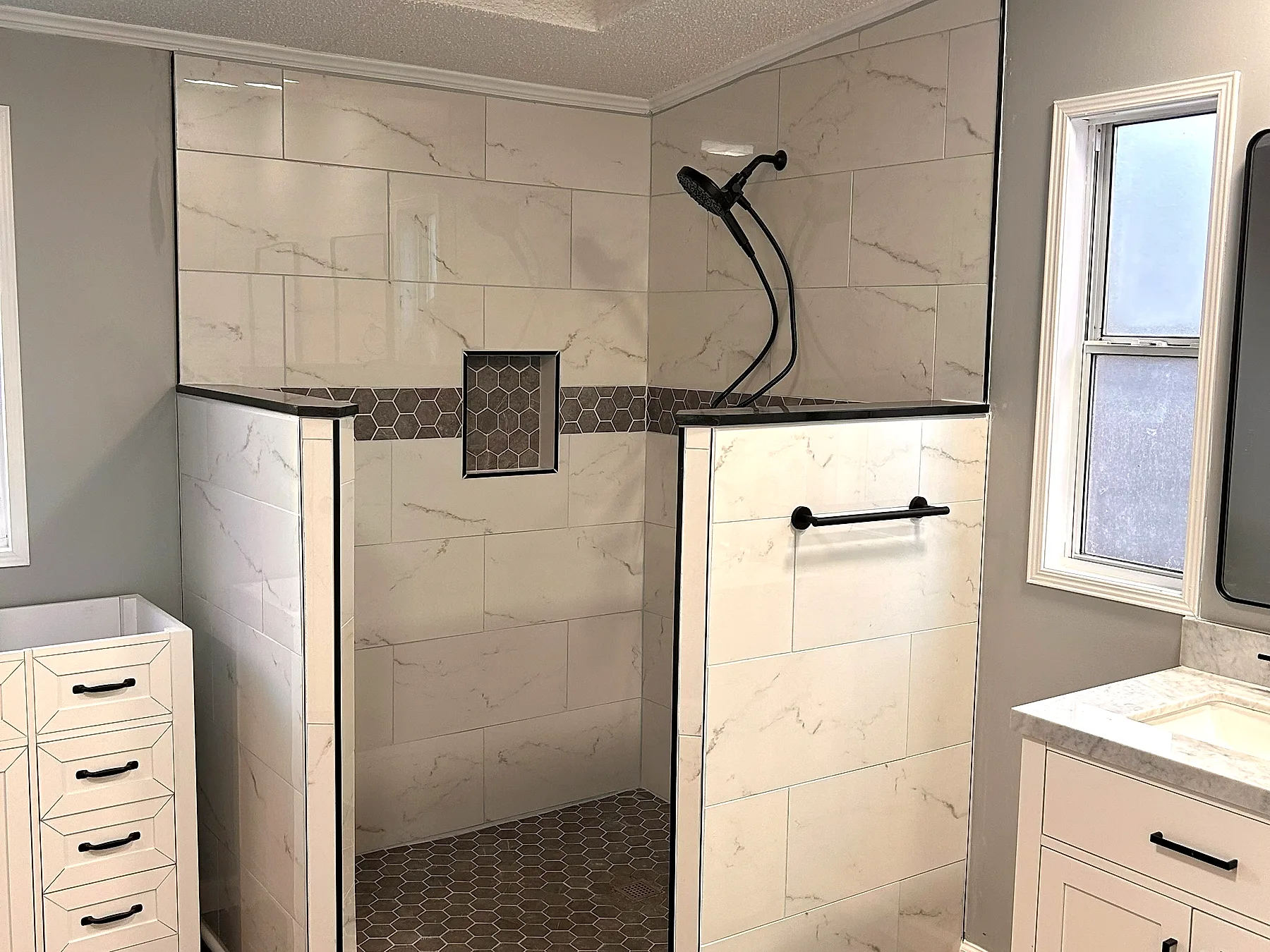
How much does a bathroom remodel cost in Simpsonville, SC?
A bathroom remodel in Simpsonville and Fountain Inn typically runs $6,375 to $30,708 for a full bath, depending on size and scope — a basic 5×8 hall bath refresh starts around $6,375–$7,677, while a mid-range 80 sq ft primary bath runs $25,498–$30,708. Powder rooms start near $3,984, and a full-gut primary bath with custom tile and premium fixtures runs $60,103 and up. Use our bath remodel calculator for an estimate matched to your bathroom’s size and finish level.
How much does a small bathroom remodel cost?
A small bathroom — a powder room or a compact 5×8 hall bath — typically costs $3,984 to $7,677 for a basic refresh: new fixtures, vanity, flooring, and paint with the existing layout and plumbing left in place. Moving fixtures or upgrading to a full tile shower in that same small footprint pushes the mid-range tier to roughly $12,749–$15,354.
How much does a master or primary bathroom remodel cost?
A primary bathroom remodel typically runs $25,498 to $98,018 depending on size and scope. An 80 sq ft primary bath with a tile shower and updated vanity at the mid-range tier runs about $25,498–$30,708; a full-gut 96 sq ft primary bath with a custom tile shower and double vanity runs $60,103–$72,382; and a large 130+ sq ft spa bath with a freestanding soaking tub, heated floors, and frameless glass runs $81,390–$98,018.
How much does a powder room remodel cost?
A powder room (half bath, roughly 25 sq ft) typically costs $3,984 to $4,798 for a basic refresh — new vanity, toilet, floor tile, lighting, and paint, with no tub or shower involved. Since a powder room has no wet area to waterproof, it’s consistently the least expensive full bathroom project we quote.
Common Bathroom Remodeling Projects
Real-world project examples with typical costs in Upstate SC:
| Project Type | Size | Typical Cost | Details |
|---|---|---|---|
| Powder Room Refresh | ~25 sq ft, half bath | $3,984–$4,798 | New vanity, toilet, floor tile, lighting, and paint with the existing layout retained — no tub or shower involved |
| Hall/Guest Bath — Basic Refresh | 5×8 (40 sq ft) | $6,375–$7,677 | New fixtures, vanity, and paint with the existing tub/shower location and plumbing left in place |
| Hall/Guest Bath — Mid-Range Remodel | 5×8 (40 sq ft) | $12,749–$15,354 | New tile, vanity, and tub/shower with some layout adjustments — the most common full bathroom remodel scope |
| Standard Primary Bath | ~80 sq ft | $25,498–$30,708 | Tile shower, vanity, updated lighting and ventilation, moderate layout changes |
| Full-Gut Primary Bath | 8×12 (96 sq ft) | $60,103–$72,382 | Complete reconfiguration, custom tile shower, double vanity, premium fixtures |
| Large Primary / Spa Bath | 130+ sq ft | $81,390–$98,018 | Custom tile shower, freestanding soaking tub, heated floors, frameless glass, premium fixtures throughout |
What We Handle
Structural & Mechanical
- Demolition and debris haul-off
- Subfloor inspection and rot/water-damage remediation
- Plumbing rough-in: supply lines, drain, vent relocation
- Electrical: dedicated 20-amp circuit, GFCI receptacles, lighting, exhaust fan wiring
- Framing changes for niches, benches, curbless shower drops, or wall relocation
- Shower pan and full waterproofing membrane (Schluter-KERDI or equivalent)
- Backer board and moisture management
- Ventilation — exhaust fan sized and ducted to the exterior
Finishes & Fixtures
- Floor tile, wall tile, shower tile, niches, curbs and thresholds
- Vanity, countertop, sink, and faucet
- Tub, shower valve and trim, shower door or glass enclosure
- Toilet
- Mirrors, medicine cabinets, lighting, hardware
- Paint, trim, door and casing work
- Optional upgrades: heated floors, benches, linear drains, steam
Bathroom Remodeling Pricing Breakdown
Three pricing tiers to match your project scope and budget:
| Tier | Price Range | What's Included |
|---|---|---|
| Basic Bath Refresh | $159-192/sq ft | New fixtures, vanity, flooring, and paint with the existing layout and plumbing locations retained. The right tier for powder rooms and bathrooms that don’t need layout changes. |
| Mid-Range Bath Remodel | $319-384/sq ft | New tile, vanity, and tub/shower with some layout adjustments. The most common scope for a full hall or primary bathroom remodel. |
| Full-Gut Renovation | $626-754/sq ft | Complete reconfiguration, relocated plumbing, custom tile shower, and premium fixtures — for primary baths being rebuilt from the studs out. |
Additional Costs to Consider
Beyond base construction, budget for these potential expenses:
-
Heated Tile Flooring
+$1,200 per bath
Electric radiant mat under tile, its own thermostat circuit
-
Freestanding Soaking Tub
+$3,500 per tub
May require floor framing reinforcement depending on the model
-
Curbless Walk-In Shower Upgrade
+$2,800 per shower
Zero-entry pan, sloped floor to a drain instead of a raised threshold
-
Double Vanity Upgrade
+$1,800 per vanity
Widened cabinet, second sink and faucet rough-in
Why Bathroom Remodels Cost What They Cost
Labor typically accounts for 45-60% of a bathroom remodel budget — a higher share than almost any other room in the house. A bathroom crams plumbing, electrical, waterproofing, tile, and finish carpentry into a space smaller than most bedrooms' closets, and every one of those trades has to show up and do real work even in a small room. There's no such thing as a small mistake behind tile: a waterproofing shortcut that would go unnoticed on paper turns into a rotted subfloor eighteen months later. That's why a $72K bathroom and a $72K deck are not comparable projects, even at the same price.
Is a bathroom remodel worth it at resale?
A minor or mid-range bathroom remodel is one of the better-returning projects a homeowner can make. In the 2026 Remodeling Cost vs. Value data, a midrange bathroom remodel recoups roughly 74-80% of its cost at resale — the highest that figure has been since 2007 — while a small cosmetic refresh under $5,000 (new fixtures, paint, a vanity swap) can return 80-100%. Full luxury bathroom renovations return less proportionally, typically in the 45-60% range, because premium finishes don't add dollar-for-dollar value to most buyer pools. That doesn't make a luxury bath a bad decision — it means a luxury bath is bought for how a family lives in it, not for resale math, while a mid-range remodel is the closer thing to a pure financial play. In the Simpsonville market, where the median home price sits around $400,000 as of mid-2026 in a corridor built out heavily since 2000, an original builder-grade bathroom is one of the more visible things a buyer notices walking through a listing.
How does Upstate SC compare to national averages?
This Old House's 2026 data puts the national bathroom remodel average around $15,586, with a common range of roughly $6,456-$24,715, and per-square-foot figures spanning about $70-$250 depending on scope (budget work runs closer to $80-$120/sq ft, mid-range $180-$280/sq ft, and luxury $500-$800+/sq ft in most national guides). Greenville and Laurens County labor rates track close to national, and material costs have largely converged with national pricing since 2022 as supply chains normalized. The gap homeowners usually notice is between a "national average" they saw in a headline and a real local quote — national averages are pulled down by cosmetic refreshes and DIY-adjacent work, so an honest full-scope quote from a licensed contractor often lands above the number a quick search turns up.
Bathroom Remodel Permits & Code Requirements — Greenville & Laurens County
Yes — most bathroom remodels in Greenville County require a permit. Greenville County requires a permit any time a new building is constructed, structural changes are made within a building, or additions are made to an existing structure, and more specifically flags bathroom remodels over $5,000 or work touching the foundation, framing, plumbing, electrical, or HVAC. A purely cosmetic refresh — paint, a like-for-like vanity swap, a new mirror, a toilet replaced in the same spot — typically doesn't need one. Anything that opens a wall, moves a fixture, or adds a circuit does. Burch Contracting pulls all required permits under SC license #CLG118679 as part of the contract; homeowners don't file anything themselves. The City of Simpsonville and the City of Fountain Inn administer permits within their municipal limits, unincorporated areas fall under Greenville County, and Laurens County covers the Gray Court and Laurens service areas — call ahead rather than guess which jurisdiction applies to a given address.
| Requirement | Standard |
|---|---|
| Minimum shower size | 900 sq in interior cross-sectional area, minimum 30" in any dimension (IRC R307.2) |
| Toilet clearance | 15" minimum from centerline to any wall, partition, or fixture (30" total width); 21" clear in front (IRC R307.1) |
| Shower/tub valve | Pressure-balancing or thermostatic mixing valve required, field-set to a maximum of 120°F (IPC 424.3) |
| Safety glazing | Required for glass within 60" horizontally of a tub or shower's edge, or less than 60" above the floor |
| Bathroom receptacles | GFCI protection required on all bathroom receptacles (2020 NEC 210.8(A)(1)) |
| Bathroom circuit | At least one dedicated 20-amp, 120V circuit supplying the bathroom's receptacle outlets (2020 NEC 210.11(C)(3)) |
| Receptacle placement | At least one receptacle required within 36" of the outside edge of each lavatory basin |
| Exhaust ventilation | 50 CFM intermittent or 20 CFM continuous, ducted to the exterior — never into the attic (IRC M1507) |
| Ceiling height | 7'6" generally; showers and tub/shower areas may run as low as 6'8" (80") over the fixture |
Code sections and adopted editions confirmed against the South Carolina Building Codes Council and Greenville County Building Safety as of the last-reviewed date below. Local amendments can vary by jurisdiction — confirm project-specific requirements with the county or city before finalizing a design. Questions on a specific address: Greenville County Building Safety, 864.467.7060.
What Drives a Bathroom Remodel Price Up or Down
What pushes cost up
- Relocating plumbing fixtures instead of keeping the existing layout
- Curbless (zero-entry) showers and linear drains
- Large-format, natural stone, or intricate-pattern tile
- Frameless glass shower enclosures
- Double vanities, heated floors, and structural changes
- Older homes with cast-iron drains, knob-and-tube wiring, or second-floor baths
What keeps cost down
- Keeping plumbing fixtures in their existing locations
- Prefab shower base with tiled walls instead of a full custom pan
- Stock vanity instead of custom cabinetry
- Ceramic tile instead of porcelain or natural stone
- Single vanity and a standard alcove tub or shower
- Bundling with another project already underway in the same house
Our Simple Process
-
1
Design & Selections
Measurements, layout, fixture and tile selections, quote lock, and permit application — runs 1-3 weeks in parallel with ordering long-lead items like custom vanities and specialty tile before demolition even starts.
-
2
Demolition & Rough-In
Protection of adjacent flooring, full demo to the studs, debris haul-off, subfloor inspection, and plumbing/electrical rough-in. This is when hidden problems surface — old galvanized supply lines, water damage, undersized framing.
-
3
Waterproofing & Backer Board
Rough-in inspections passed, insulation, cement board and waterproofing membrane installed, shower pan set and flood-tested, drywall hung and finished.
-
4
Tile & Fixtures
Floor and wall tile set and grouted, tub or shower base installed, vanity and countertop set, toilet and fixtures installed, paint.
-
5
Trim, Glass & Final Walkthrough
Shower glass installed last since it’s measured after tile, then mirrors, lighting, hardware, trim, caulk, final inspection, punch list, and walkthrough.
Materials & Design Choices That Matter
Tile
Porcelain's low water absorption is why it dominates wet areas over ceramic, and natural stone brings a premium look at a premium price and sealing schedule. Large-format tile means fewer grout lines — 89% of design professionals surveyed for NKBA's 2026 Bath Trends Report want smaller or no grout lines, and 80% expect large-format tile to lead the bathroom market over the next three years — but large format demands a flatter substrate and more prep labor, not less.
Waterproofing
This is the single most important decision nobody sees once the tile is on. A sheet or liquid waterproofing membrane (Schluter-KERDI or equivalent) behind tile and under a shower pan is what separates a remodel that lasts decades from one that rots the subfloor in three years. "Greenboard and hope" is not a waterproofing system, no matter how good the tile above it looks on day one.
Showers
Curbless (zero-entry) showers, linear drains, wet rooms, niches, and benches are the direction the whole category is moving — 55% of design professionals now say a larger shower matters more than having a bathtub at all. A curbless shower (a shower with no raised threshold, floor sloped to a drain instead) reads as both more accessible and more modern, which is why it shows up on both the ADA and the luxury end of this page's project list.
Ventilation
Correct CFM sizing and ducting straight to the exterior — never into the attic — is the least glamorous decision in a bathroom remodel and the one most likely to cause a callback if it's wrong. Undersized or improperly vented exhaust is the single most common cause of premature failure in an otherwise well-built bathroom: trapped humidity finds the nearest wood it can rot.
Vanities & counters
Stock, semi-custom, and full-custom vanities span a wide price range, and quartz, granite, and cultured marble each have a different maintenance profile. Wood-faced vanities have overtaken painted finishes in 2026 preference (62% vs. 53% in NKBA's survey) as biophilic, natural-material design keeps gaining ground in the bath.
Fixtures & finishes
Matte (54%), brushed (51%), and satin (46%) finishes now outpace polished chrome (39%) in the same NKBA survey. Mixing metals within a bathroom is fine; mixing undertones — warm brass against a cool-toned gray tile, for instance — is the mistake that makes a finished bathroom feel slightly off without an obvious reason why.
Lighting
91% of design professionals rank lighting quality as a top consideration, 92% say task lighting belongs in every primary bath, 88% prioritize natural light, and 80% are specifying nighttime-specific lighting for overnight bathroom trips. Layer ambient, task, and night lighting — and get the mirror lighting right, because nothing else in the room photographs well if that's wrong.
Aging in place
Blocking the walls for future grab bars during a remodel costs almost nothing; adding it after the tile is up costs real money and a torn-out wall. 32% of design professionals now consider aging-in-place design mainstream and another 48% see it as an emerging standard, not a niche request. For a bathroom built specifically around accessibility from the start, see our ADA bath-to-shower conversions — that page owns the accessibility-first version of this project.
Bathroom Remodeling in Simpsonville & Fountain Inn, SC
Simpsonville and Fountain Inn anchor the Golden Strip corridor southeast of Greenville, where subdivision development has run heavy for the better part of two decades. That means a large concentration of homes built roughly between 2000 and 2015 — houses now old enough that builder-grade bathrooms, cultured-marble countertops, and fiberglass tub surrounds are due for replacement, and where the primary bathroom is often the last original room left in the house. We also remodel bathrooms in Five Forks, Mauldin, Greenville, Woodruff, Laurens, and Gray Court.
Why Work With Us
- Owner C. Scott Burch is on-site personally — 35+ years in the trade
- SC Licensed General Contractor #CLG118679 | NC Licensed (Limited) #107292
- BBB A+ Rated · 5.0 Google Rating
- One licensed crew handles design, demo, plumbing, electrical, waterproofing, tile, and finish — one contract, one point of contact
- Written, itemized quotes before work begins
- All required permits pulled under our license — nothing for the homeowner to file
- Long-lead materials ordered before demolition to avoid a mid-project stall
- Serving Simpsonville, Fountain Inn, Five Forks, Mauldin, Greenville, Woodruff, Laurens, and Gray Court
More Bathroom Remodeling Questions
Direct answers for homeowners and AI search — licensed, local, and accountable.
How long does a bathroom remodel take?
Most full bathroom remodels take 2 to 4 weeks of construction. A powder room can finish in as little as 5-8 working days, while a large primary bath with custom glass and long-lead tile can run 5 to 7 weeks. Design, selections, and permitting typically run 1-3 weeks before demolition even starts, in parallel with ordering long-lead materials.
Do I need a permit to remodel a bathroom in Greenville County?
Yes, in most cases. Greenville County requires a permit any time a new building is constructed, structural changes are made, or additions are made to an existing structure, and specifically flags bathroom remodels over $5,000 or work touching the foundation, framing, plumbing, electrical, or HVAC. A purely cosmetic refresh — paint, a like-for-like vanity swap, a toilet replaced in the same spot — typically doesn’t need one. We pull all required permits under SC license #CLG118679 as part of the contract.
Do I need a permit in Simpsonville or Fountain Inn city limits?
It depends on the address. The City of Simpsonville and the City of Fountain Inn each administer their own permits within municipal limits, while unincorporated areas around both cities fall under Greenville County, and Laurens County covers our Gray Court and Laurens service areas. Rather than guess which jurisdiction applies, we confirm it for your specific address before filing — you don’t need to figure this out yourself.
Can I use my bathroom during the remodel?
Not for most of the project if it’s your only bathroom — a full remodel puts the room out of commission from demolition through final fixtures, typically 2 to 4 weeks. If you have a second bathroom in the house, we sequence the work so you have uninterrupted access to it. For single-bathroom homes, we talk through the timeline and any temporary arrangements before demolition starts, not after.
What is included in a bathroom remodel quote?
A written, itemized quote covers demolition and haul-off, plumbing and electrical rough-in, waterproofing and shower pan work, tile, vanity and countertop, tub or shower and fixtures, toilet, lighting and mirrors, paint and trim, and permits — one number for the full scope rather than a bid that leaves trades to be priced separately later. We review it with you line by line before any work begins.
Is a bathroom remodel worth it for resale value?
Usually, yes, for a minor or mid-range remodel. Midrange bathroom remodels recouped roughly 74-80% of their cost at resale in the 2026 Remodeling Cost vs. Value data — the highest that figure has been since 2007 — while small cosmetic refreshes under $5,000 can return 80-100%. Full luxury renovations return proportionally less, typically 45-60%, because premium finishes don’t add dollar-for-dollar value; a luxury bath is more often bought for daily living than for resale math.
Should I move the plumbing or keep the existing layout?
Keeping the existing plumbing locations is the single biggest lever for controlling cost — relocating a toilet, shower, or vanity drain means opening the floor or walls, which is the difference between a basic refresh and a mid-range or full-gut budget. Moving plumbing makes sense when the current layout genuinely doesn’t work (a cramped shower, an awkwardly placed vanity), but it’s rarely worth it purely for aesthetics.
How much does a tub-to-shower conversion cost?
An accessible, ADA-style roll-in tub-to-shower conversion — demo, new pan, waterproofing, tile or fiberglass surround, grab bars, and a low-threshold entry — typically runs $10,500 to $19,800 with us. A standard (non-accessible) conversion that keeps a curb and skips ADA-specific items like a roll-in base and extra grab bars usually costs less than that range, since it drops the accessibility-specific line items. See our ADA bath-to-shower conversions for the accessible version and its calculator.
Should I keep a bathtub in the house?
If the house has at least one other bathtub, converting a secondary bath to a walk-in shower is increasingly common and won’t hurt resale — 55% of design professionals surveyed for NKBA’s 2026 Bath Trends Report say a larger shower now matters more to buyers than having a bathtub. If this would be the only tub in the house, we generally recommend keeping at least one somewhere, since some buyers with young children specifically look for it.
What is a curbless (zero-entry) shower and what does it cost?
A curbless shower has no raised threshold — the floor slopes gently to a drain instead, so you step or roll straight in at the same level as the rest of the bathroom floor. It reads as both modern and more accessible, which is why it shows up on both budget-conscious and luxury remodels. As an upgrade to an existing shower plan, it typically adds around $2,800 to the project.
What is the most common hidden cost in a bathroom remodel?
Water damage found once demolition opens the walls or floor — rotted subfloor around an old tub, a slow leak that was never visible from outside the wall, or corroded galvanized supply lines. This is also why we order long-lead materials like custom vanities and specialty tile before demolition starts: it’s the mid-project stall, not the surprise itself, that actually derails a schedule.
How do you protect the rest of my house during construction?
We protect adjacent flooring and hallways before demolition starts, seal off the work area to control dust, and haul debris out through a route we walk with you in advance rather than through the rest of the house. Every project is managed personally by Scott Burch, so the same person you talked to during the quote is checking on protection and cleanup throughout.
Do you provide design, or do I need a designer first?
We work design-build, handling layout, fixture and tile selections, demolition, structural work, electrical, plumbing, and finishing under one roof. You don’t need to line up a separate designer and contractor — we manage all phases so decisions stay coordinated and on budget instead of getting relayed between two companies.
Who buys the fixtures and tile — you or me?
Either way works. Most clients let us source fixtures and tile as part of the itemized quote, which keeps warranty and delivery scheduling under one contract. If you’d rather select and purchase specific pieces yourself — a particular vanity or a tile you’ve already fallen in love with — we build the quote around owner-supplied materials and coordinate delivery timing with the schedule.
What waterproofing system do you use and why does it matter?
We use a sheet or liquid waterproofing membrane system (Schluter-KERDI or equivalent) behind tile and under every shower pan, not just a cement backer board on its own. This is the single most important decision nobody sees once the tile goes up — it’s the difference between a shower that lasts decades and one that quietly rots the subfloor within a few years.
What size exhaust fan does my bathroom need?
Code requires at least 50 CFM for a fan that runs intermittently (tied to the light switch) or 20 CFM for one that runs continuously at low speed, ducted straight to the exterior — never into the attic. Larger bathrooms, steam showers, or rooms with poor natural airflow often benefit from sizing above the code minimum; undersized or improperly vented ventilation is the most common cause of premature failure in an otherwise well-built bathroom.
How do I know a bathroom contractor is properly licensed in South Carolina?
Ask for their SC Residential Builders Commission license number and verify it directly on the South Carolina LLR website — it takes about a minute. Burch Contracting holds SC General Contractor License #CLG118679 and NC General Contractor License (Limited) #107292, and we’re glad to have you verify either one before signing anything.
Do you offer financing?
No, we don’t offer financing. Payment is arranged directly with us under the terms in your written contract — ask during your consultation how we structure payments for a project of your size.
What warranty do you provide on bathroom remodels?
Workmanship is covered by a 1-year warranty. On top of that, every product — fixtures, tile, tub, vanity — carries its manufacturer’s warranty, which transfers to you as the homeowner under that manufacturer’s written terms.
How do I get started and what does the first visit cost?
Call (864) 724-4600 or request a consultation online — the initial visit and ballpark estimate are free. We walk the space, talk through scope and budget, and follow up with a written, itemized quote so you know the real number before committing to anything.
Ready to Start Your Bathroom Remodeling Project?
Free consultation and ballpark estimate. A+ BBB Rating, 5.0 Google Rating, 35+ years serving Upstate SC.